Academic Research
The Evolution of Research into Systemic Leadership Since 1998
Our fundamental understanding of systemic leadership has given rise to a continuous process of research and development over the past three decades. Each stage of development has addressed new questions arising from leadership practice—ranging from systemic leadership and the "Sphere Model" to hybrid leadership in the age of AI.
Prof. Daniel F. Pinnow—the founder and visionary behind systemic leadership—has consistently advanced this approach since 1998, transforming it over the years into one of the world’s most modern leadership concepts. What began as an innovative impulse has evolved into a research process spanning nearly 30 years and multiple stages of development—a process that continues to this day.
From the early foundations of systemic leadership and its adaptation for the "organization of the future" (featuring seven core competencies) to the Sphere Model and recent expansions, systemic leadership represents a dynamic, long-term research program. It responds to increasingly complex, dynamic, and uncertain environments, placing the capacity for leadership within social systems at the heart of the framework.
Today, this approach ranks among the most modern leadership theories because it combines classic leadership tools with perspectives from systems theory, cybernetics, and organizational psychology. At the same time, the model is continuously refined to incorporate the new leadership challenges posed by digital, interconnected, and data-driven organizations.
A current focus of my work is how AI algorithms actively intervene in leadership processes and interact with human leaders. I examine the role of AI as a "co-actor" within complex social systems—acting as a decision-support tool, a feedback system, and an observer of organizational patterns. In doing so, I am adding a new dimension to the systemic leadership approach: one in which humans and AI share responsibility for effective leadership decisions. On this basis, I position myself as a leading thought leader in modern leadership, combining nearly 30 years of research into systemic leadership with the latest insights into AI-driven leadership processes. The dp-Akademie serves as the central laboratory and practical platform where this theory is tested, reflected upon, and further developed through behavior-oriented leadership seminars, coaching programs, and in-house consulting.
Current Research Approach 2026: Systemic Leadership 4.0 – Leadership in the Age of Artificial Intelligence
Since the development of Systemic Leadership in 1998, the working world has undergone fundamental change. What began with the integration of systemic thinking into leadership—evolving through the "spheres model" to Systemic Leadership 3.0—now faces a new challenge:
Artificial intelligence is not merely transforming work processes; it is transforming leadership itself.
Algorithms are already making decisions, prioritizing information, evaluating performance, and influencing communication. This introduces a new, previously overlooked actor into the leadership system alongside managers and employees.
Systemic Leadership 4.0 therefore expands the classic systemic leadership approach to include the dimension of intelligent AI systems. It examines how leaders can ensure responsibility, provide direction, and maintain decision-making capabilities within organizations as algorithms increasingly become active co-shapers of the process.
The foundations of this new approach are currently being further developed as part of a book project with the working title *Machtwechsel im Untergrund – Wie KI-Algorithmen die Führung übernehmen* ("Shift of Power Underground: How AI Algorithms Are Taking Over Leadership"). Publication is scheduled for 2026.
Why I Rethink Leadership Today
My understanding of leadership was not formed at a desk, but through more than three decades of practical leadership experience and international projects—ranging from the training of Russian executives and collaboration with global companies to research stays in North America and teaching assignments in China. These experiences have played a decisive role in shaping the systemic leadership approach. Evolution of Systemic Leadership
1998 – Development of the foundations of systemic leadership
2005 – Publication of the foundational work *Führen – Worauf es wirklich ankommt* (Systemic Leadership 1.0)
2011 – Publication of the book *Unternehmensorganisationen der Zukunft* (Corporate Organizations of the Future): four levels of interaction and seven core competencies – Systemic Leadership 2.0
2014 – Publication of the Spheres Model of Systemic Leadership as a white paper – Systemic Leadership 3.0
2026 – Systemic Leadership 4.0: Leadership in hybrid systems comprising humans and AI (in development)
Up to date Research: Spheremodell of systemic Leadership
 Fig. Sphere Modell of systemic Leadership by Daniel F. Pinnow 2014
The systemic approach to leadership considers managers, first and foremost, as a part of a complex system, which is constantly at change. It does not consider the art of leadership as one who manages these systems themselves, but rather one who manages the relations and networks within these systems.
In doing so, a systemic leader does not focus on the superficial symptoms of the system, but rather looks at what is happening underneath its surface. He or she analyzes the factual, social and timely patterns and processes out of which the system consists. This enables a systemic leader to lead his staff in an indirect way, rather than being directive and patronizing.
In this spirit, leadership means creating a world in which others want to be a part of. More concretely, a CEO who is leading his staff according to the systemic approach, would not just delegate tasks, but rather see what can be done and influenced together with his managers and workers in order to steer the company in the right direction.
Published in: Whitepaper: „Sphären Modell“ der Systemischen Führung, Daniel F. Pinnow, April 2014
Academic Research 2011: Systemic Leadership in the "VUKA World"
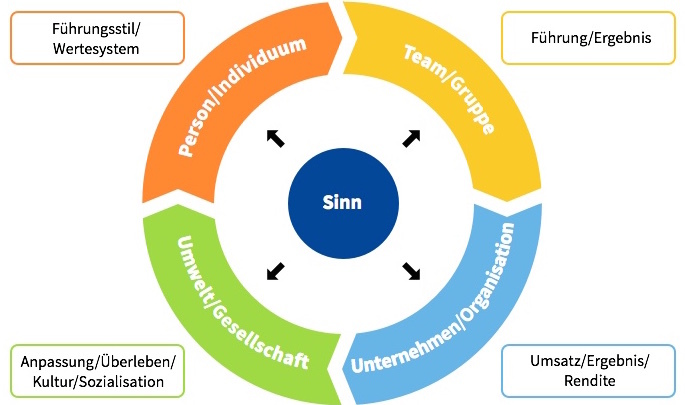
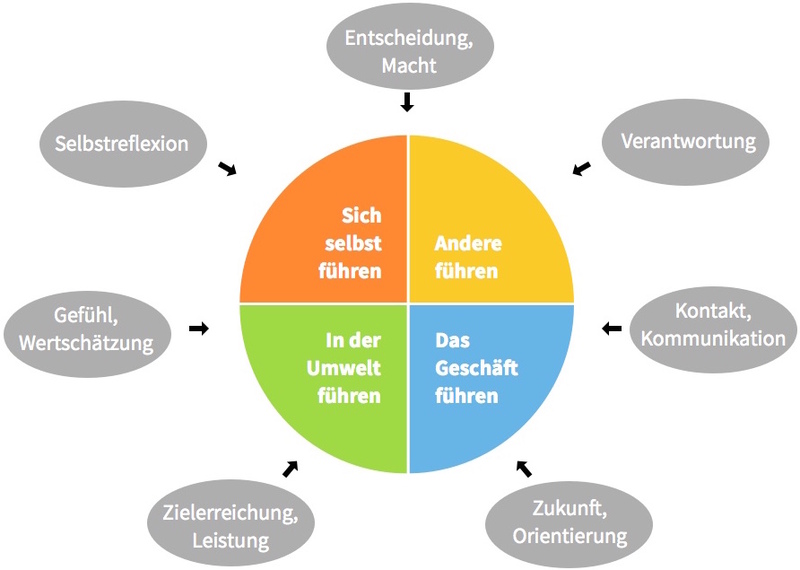
Fig. The 4 Interaction Levels of Leadership by Daniel F. Pinnow, 2011 Fig. The 7 Core competencies of Executive Coaching - Prof. Daniel F. Pinnow, 2011
In this evolution of the original research approach of 2005, the leadership understanding consists of seven core competencies that a leader must bring with him when he wants to stand up in the energy square: "I myself - my company - my team and my employees - my environment". Success has, who does not stay with failures and mistakes, but future-oriented looks forward, makes decisions and takes responsibility. In order for this action and decision to be in harmony with other systems, lifeworlds and fellow human beings, the executive must be in contact with others, who can reflect their own thoughts and actions and above all, communicate well. All this is only possible if she can not only guide and guide with numbers, data, facts, but also gives respect and attention to the emotional level. Anything but easy. But a wide field on which one can prove himself.
Published in: Unternehmensorganisationen der Zukunft - Erfolgreich durch systemische Führung, Daniel F. Pinnow, Campus Verlag, 2011
Research Approach 2005: The leader as part of the system
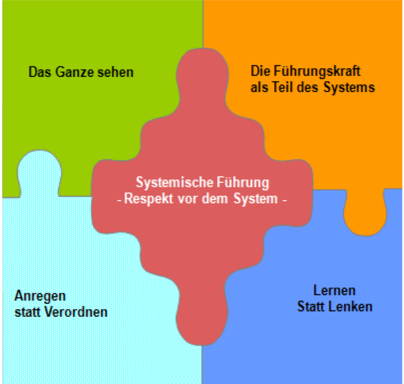 Fig. Systemic Leadership - Daniel F. Pinnow, 2005
In this fundamental approach to systemic leadership, first developed by Daniel F. Pinnow in 2002 and published in 2005 in his book "Leading - What really matters," a leader sees himself above all as part of a complex system that grows constantly changed. The art of leadership is not to manage this system, but its relationships.
To do this, a systemic-thinking leader deliberately turns his attention away from the superficial symptoms of their system. Modern leaders go one level deeper: they analyze the factual, social, and temporal patterns and processes underlying their respective systems. With these insights, she guides her employees indirectly and from within the system rather than directly and from above.
In this sense, modern leadership, according to Daniel F. Pinnow, means: "To lead means to shape a world that other people would like to belong to".
Published in: Führen – Worauf es wirklich ankommt, Daniel F. Pinnow, GablerSpringer Verlag, 2005